
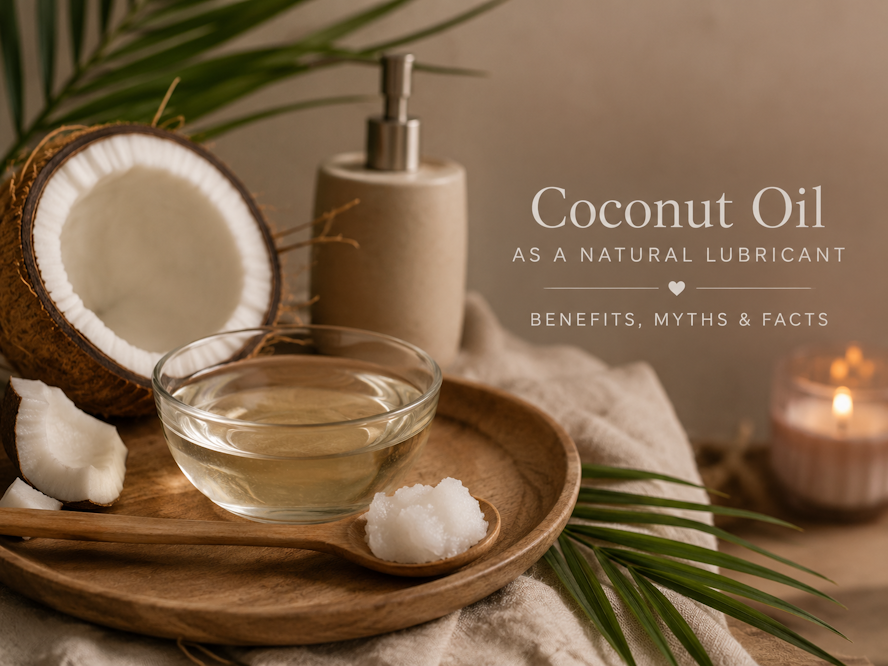
Why So Many People Are Turning to Coconut Oil as a Natural Lubricant
One of the most common questions we hear is: “Can you use coconut oil as a lubricant?”
The short answer: yes — and here’s why so many people love it.
More people are discovering the appeal of simple, plant-based intimate products that feel beautifully smooth and comfortable to use.
Coconut oil as a natural lubricant offers a silky, long-lasting glide and a wonderfully simple approach to intimacy.

The Real Benefits of Coconut Oil as a Natural Lubricant
1. It lasts longer than water-based lubricants
People often ask: “Why do people prefer coconut oil over water-based options?”
One of the biggest differences is how the two formulas behave during use.
Water-based lubricants gradually evaporate and may need to be reapplied, whereas coconut oil remains on the skin for longer.
At body temperature, coconut oil spreads easily and creates a smooth, cushioning layer that helps reduce friction without needing constant reapplication.
A little also goes a surprisingly long way.
2. A simple, plant-based formula
For people who prefer a more minimalist approach to intimate care, coconut oil has an obvious appeal.
Its light, smooth texture spreads easily across the skin, while its emollient properties leave the skin feeling soft and moisturised.
That combination of lubrication and skin feel can be particularly welcome when dryness makes intimacy less comfortable, including during peri- and post-menopause.
Individual needs and sensitivities vary, of course, so—as with any intimate product—what feels comfortable is personal to you.
3. It feels different from a traditional lubricant gel
Texture is one of the biggest practical differences between an oil-based and water-based lubricant.
Coconut oil has a fluid, silky consistency rather than the gel-like texture associated with many traditional lubricants.
It spreads easily across the skin and stays workable for longer, making it particularly suited to people who prefer an oil rather than a gel.
The choice between oil-based and water-based lubricant ultimately comes down to how you intend to use it and the texture you prefer.
4. It can make dryness during intimacy more comfortable
When natural lubrication is reduced, additional lubrication helps create a layer between the skin that reduces friction during intimate contact.
Coconut oil’s emollient properties also leave the skin feeling soft and moisturised, rather than simply providing slip during use.
This combination of lubrication and skin feel is one reason oils are particularly popular with people experiencing intimate dryness.
Dryness can occur for many reasons and is especially common around peri- and post-menopause.
Persistent, painful or unexplained intimate dryness should always be discussed with an appropriate healthcare professional.
5. It works beautifully beyond the bedroom
One of coconut oil’s most useful qualities is its versatility.
The same smooth texture that makes it suitable for intimate lubrication also lends itself naturally to massage and touch.
Use it for:
full-body massage
intimacy
warm-up and sensual touch
moisturising the skin
Rather than switching between a massage product and an intimate oil, a well-formulated coconut-based product can comfortably perform both roles.
Important: oil-based lubricants, including coconut oil, should not be used with latex condoms because oils can weaken latex.
If condoms or intimate toys are part of your routine, always check the manufacturer’s compatibility guidance first.
Myths About Using Coconut Oil as a Natural Lubricant
Myth 1: It’s not safe
Many people Google: “Is coconut oil safe as a lubricant?”
Coconut oil is widely used in personal care, including as an intimate oil.
BCH Naturals’ own coconut-oil formulation has undergone a Cosmetic Product Safety Assessment for its intended use.
There is one important compatibility rule: oil-based lubricants should not be used with latex condoms, because oil can weaken latex.
If you’re using condoms made from another material, always check the manufacturer’s compatibility instructions.
As with any cosmetic product, individual sensitivities can vary.
Safety isn’t unique to coconut oil, either — here’s what actually makes any natural lubricant safe to use.
Myth 2: Coconut oil inevitably causes intimate problems
There is plenty of conflicting advice online about coconut oil and intimate use, which can make it difficult to separate personal experience from reliable information.
The important distinction is that a cosmetic lubricant is designed to provide lubrication, reduce friction and enhance comfort during intimacy.
BCH Naturals uses a simple oil-based formulation that has been independently safety assessed for its intended cosmetic use.
If you experience persistent irritation, pain or unusual symptoms, speak to an appropriate healthcare professional for advice.
Myth 3: It’s too heavy
Not all coconut-oil products have the same texture. BCH Naturals’ formulation is a fluid oil rather than the solid coconut oil you may associate with the kitchen.
It spreads easily, provides lasting lubrication and leaves the skin feeling soft — without the gel-like texture of a traditional water-based lubricant.
The Science Behind Coconut Oil as a Lubricant
Lubricants work by creating a layer between surfaces, allowing them to move against one another with less friction. Because coconut oil is oil-based rather than water-based, it doesn’t evaporate in the same way as a water-based lubricant and can remain workable for longer.
This is one reason a relatively small amount can provide lasting lubrication during intimacy.
Coconut oil is an emollient
Coconut oil is also an emollient — an ingredient that helps soften and smooth the skin. That makes its role slightly different from simply adding temporary slip.
Alongside providing lubrication, an oil can leave the skin feeling soft and moisturised after use. This combination of glide and skin feel is part of the appeal of coconut oil for intimate use and massage.
Texture matters
The experience of using a lubricant isn’t only about how long it lasts. Texture matters too.
A fluid coconut-oil formulation spreads easily across the skin, creating a thin, smooth layer rather than the gel-like consistency associated with many water-based lubricants. Some people prefer the lighter feel of a gel; others prefer the lasting slip of an oil. Neither format is universally “better” — they’re simply different experiences.
A simple formula still needs to be properly assessed
“Natural” doesn’t automatically mean that a product is suitable for every use or every person. Intimate products should be formulated and assessed with their intended use in mind.
BCH Naturals’ coconut-oil formulation has undergone an independent Cosmetic Product Safety Assessment for its intended cosmetic use. Individual sensitivities can still vary, just as they can with any cosmetic product.
One important difference: condom compatibility
Oil-based lubricants should not be used with latex condoms, because oils can weaken latex and increase the chance of the condom breaking.
If you use condoms made from other materials or intimate toys, check the manufacturer’s instructions for lubricant compatibility before use.

Coconut Oil Lubricant vs Water-Based Lubricant
Both oil-based and water-based lubricants can provide additional glide and reduce friction, but they behave differently during use.
The best choice depends on the experience you prefer and what you’re using your lubricant with.
Water-based lubricants
Water-based lubricants are generally:
light in texture and easy to spread
easy to wash away with water
compatible with latex condoms
suitable for use with many types of intimate toys
more likely to need reapplication as their water content evaporates
For people who prioritise condom and toy compatibility or prefer a lighter, gel-like consistency, a water-based lubricant can be the more practical choice.
Coconut oil as a natural lubricant
Coconut oil offers a different experience. As an oil-based lubricant, it:
provides long-lasting lubrication
doesn’t evaporate like a water-based formula
spreads easily across the skin
has emollient properties that leave skin feeling soft
works particularly well for massage and sensual touch as well as intimacy
For people who prefer the feel and staying power of an oil, coconut oil can provide a smooth alternative to a traditional water-based gel.
So, which should you choose?
There’s no single lubricant type that’s right for everyone.
Choose according to the texture you enjoy, how long you want the lubrication to last and, importantly, what you plan to use it with.
If you use latex condoms, choose a compatible water-based lubricant rather than coconut oil.
Oil-based lubricants can weaken latex. For non-latex condoms and intimate toys, always follow the manufacturer’s lubricant compatibility guidance.
According to the Cleveland Clinic, natural oils including coconut oil, hemp seed oil and olive oil are acceptable lubricant options. It also notes that oil-based lubricants “tend to be the longest-lasting”, while cautioning that oils should not be used with latex condoms or dental dams.
💗 Why BCH Naturals Glide & Slide Is Special
Not every intimate oil is formulated in the same way.
BCH Naturals Glide & Slide is a simple, plant-based intimate and massage oil made with coconut oil and hemp seed oil. The formulation has been independently assessed for its intended cosmetic use, giving you the reassurance of a product created specifically with intimate use in mind.
Glide & Slide:
combines coconut oil with hemp seed oil
is fragrance-free
is made in the UK
provides smooth, long-lasting lubrication
leaves the skin feeling soft and moisturised
is designed for both intimacy and massage
has undergone an independent Cosmetic Product Safety Assessment for its intended use
Sometimes, keeping things simple really is the point
How to Use Coconut Oil as a Natural Lubricant
A little goes a long way with an oil-based lubricant, so there's no need to use too much at once.
• Start with a small amount. Dispense a little into your hands or directly onto the desired area.
• Spread gently. Allow the oil to distribute naturally across the skin.
• Add more if needed. Because an oil-based lubricant doesn't evaporate like a water-based formula, you may find that less frequent reapplication is needed.
• For massage, build gradually. Start with a small amount and add more as required for the level of glide you prefer.
• Check compatibility before use. Coconut-oil lubricants should not be used with latex condoms because oil can weaken latex. Always check the manufacturer's guidance when using non-latex condoms or intimate toys.
There's no perfect amount for everyone — comfort and preference are individual. Start small and adjust as needed.
Is Coconut Oil Safe for Toys?
Coconut oil can be used with some intimate toys, but compatibility depends on the material and the manufacturer’s care instructions.
• Glass and stainless steel toys: these non-porous materials are generally compatible with oil-based lubricants, but always follow the manufacturer’s guidance.
• Silicone and other materials: check the manufacturer’s lubricant recommendations before use rather than assuming that every toy made from a particular material is oil-compatible.
• Latex: do not use coconut oil or other oil-based lubricants with latex condoms, as oil can weaken latex.
When in doubt, check the instructions supplied with your toy or contact its manufacturer before using an oil-based lubricant.
💬 Frequently Asked Questions
Can you use coconut oil as a lubricant?
Yes. Coconut oil is commonly used as an oil-based lubricant because it spreads easily, reduces friction and remains on the skin for longer than many water-based formulas.
BCH Naturals’ coconut-oil formulation has been independently safety assessed for its intended cosmetic use.
Is coconut oil safe as a lubricant?
Coconut oil is widely used in personal care and intimate products.
As with any cosmetic product, individual sensitivities can vary. If you’re choosing a formulated intimate oil, look for a product that has been appropriately safety assessed for its intended use.
Oil-based lubricants should not be used with latex condoms.
Can coconut oil be used as a personal lubricant daily?
How often you use an intimate oil is a matter of personal preference and individual skin tolerance.
Follow the directions for the product you’re using and stop using it if you experience persistent discomfort or irritation.
Is coconut oil a good lubricant?
For people who enjoy an oil-based lubricant, coconut oil offers several practical qualities: it spreads easily, provides lasting lubrication and also works well for massage.
Whether an oil- or water-based lubricant suits you best depends on the texture you prefer and what you plan to use it with.
Does coconut oil help with dryness?
Coconut oil provides additional lubrication that can reduce friction when dryness makes intimacy uncomfortable.
Its emollient properties also help leave the skin feeling soft and moisturised.
Intimate dryness can have many causes, including hormonal changes around peri- and post-menopause; persistent, painful or unexplained dryness should be discussed with an appropriate healthcare professional.
Ready for a natural, luxurious glide?
If you prefer the lasting feel of an oil-based lubricant, BCH Naturals Glide & Slide combines coconut oil and hemp seed oil in a simple, plant-based formula designed for intimacy and massage.
Looking for a little more? Our Glide & Slide Extra Twin Pack gives you two bottles — perfect for keeping one close and one wherever you need it.
Nature’s gift to intimacy. 🌿
Enjoyed this read? Share it with a friend who’d appreciate a moment of calm and connection.