
Hemp Seed Oil for Skin: What the Wellness Industry Got Wrong
And why it matters now
There is an ingredient that dermatologists and cosmetic scientists have studied quietly and thoroughly for decades.
It has one of the most precisely matched fatty acid profiles for human skin of any plant oil in existence.
Its chemistry addresses some of the most common skin complaints that accompany hormonal change — dryness, sensitivity, compromised barrier function, the loss of suppleness that no amount of ordinary moisturiser seems to fix.
The wellness industry spent years selling it short. Some dismissed it as too niche. Others treated it as interchangeable with any other natural oil.
Some avoided it entirely, confused by the name.
All of them missed the point.
Here is what hemp seed oil actually does — and why, if you have dry, sensitive, or maturing skin, it may be the most useful ingredient you haven’t taken seriously enough.

What Hemp Seed Oil Is
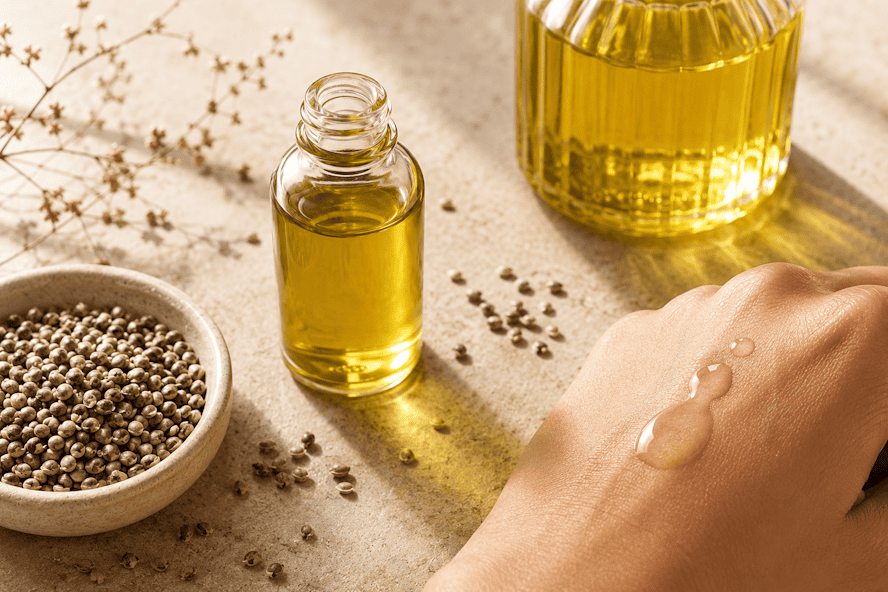
Hemp seed oil is cold-pressed from the seeds of the hemp plant
The same plant used for rope, textiles, and food for thousands of years. The seeds. Not the leaves, not the flowers — the seeds.
This distinction matters, because the seed’s nutritional profile is entirely different from any other part of the plant.
The oil is food-grade. It appears in salad dressings, smoothies, and nutritional supplements worldwide. It is regulated as a cosmetic ingredient across the EU and UK, with a long and well-documented safety record.
What makes it interesting for skin is not where it comes from. It’s what’s inside.
That fatty acid composition is the whole story. And it’s the part the wellness industry almost never explained.
The Chemistry That Actually Matters
Every plant oil has a fatty acid profile — a fingerprint of the different fats it contains. That profile determines what an oil will and won’t do for your skin.
Hemp seed oil’s profile is, to put it plainly, unusual. Here is why it stands out.
1. It is exceptionally high in linoleic acid (omega-6)
Hemp seed oil contains approximately 55–60% linoleic acid — a notably high concentration, significantly higher than many popular oils including olive, argan, and coconut.
This omega-6 is the fatty acid your skin depends on to build and maintain its outer barrier. It is a structural component of ceramides — the lipid molecules that hold the cells of your outer skin layer together, regulate moisture retention, and protect against environmental damage.
Your skin cannot manufacture it. It must come from outside. And when levels are low — through diet, age, or hormonal change — the consequences are visible: dryness, sensitivity, reactive skin, a tight, uncomfortable feeling that water alone never seems to fix.
2. It contains GLA — a rare anti-inflammatory fatty acid
Hemp seed oil also contains gamma-linolenic acid (GLA), with well-documented anti-inflammatory properties.
At around 2–4% of the oil’s composition it is a small fraction — but it is the kind of compound that earns its place in a formulation rather than simply appearing as a marketing credential, particularly in skin prone to redness or reactivity.
GLA is found naturally in relatively few plant oils. It supports skin elasticity, helps calm reactive skin, and plays a role in maintaining suppleness over time.
3. Its omega ratio is one of the most balanced of any plant oil
Hemp seed oil contains both omega-3 and omega-6 fatty acids in a ratio close to 3:1 — which mirrors the ratio considered optimal for human skin biology.
This is not a coincidence of branding. It is chemistry. And it helps explain why the oil works in harmony with the skin’s own processes rather than disrupting them.
Research confirms linoleic acid’s essential role in maintaining the skin’s outer barrier
The Skin Barrier — What It Is and Why It Breaks Down
Your skin’s outer layer is not simply dead surface cells waiting to be exfoliated. It is an active, complex structure.
Think of it as a brick wall. The bricks are skin cells. The mortar binding them together is a matrix of lipids: primarily ceramides, cholesterol, and free fatty acids.
That mortar exists in precise proportions. Disrupting it — through hormonal change, over-cleansing, or the wrong ingredients — leads to moisture escaping through a compromised outer layer. Scientists call this trans epidermal water loss.
When the barrier is compromised, moisture escapes. External irritants get in. Skin becomes reactive, tight, sensitised. It stops behaving the way it used to.
This is not merely an aesthetic concern. Barrier function is fundamental to skin health.
And it is precisely the kind of problem that omega-6-rich oils are structured to address.
What Hormonal Change Does to Skin
The Biology Nobody Explains Properly – Through perimenopause and beyond, several things happen to skin simultaneously.
Oestrogen declines. Oestrogen plays a direct role in ceramide production, collagen synthesis, and the skin’s ability to retain moisture.
As it falls, ceramide levels fall with it. The lipid mortar in the skin’s barrier thins. Skin becomes drier, less elastic, more reactive.
Sebum production decreases. The skin’s natural surface oil — which forms part of its surface protection — slows significantly.
Skin that was once balanced or slightly oily may become chronically dry.
The skin thins. Cell turnover slows. The barrier becomes less efficient at self-repair.
These changes happen gradually. Many people find that products that worked perfectly well in earlier years — cleansers, moisturisers, even water applied too frequently — start to feel harsh or stripping on skin that has less capacity to recover.
This is not imagined. It is biology.
And it explains why an omega-6-rich, barrier-supportive oil is not an optional extra at this life stage. It is, in many ways, a logical response to what the skin is actually asking for.
Not All Oils Are Equal — The Mistake Most People Make
Here is where the wellness industry has done real damage through oversimplification.
For years, “natural oil” was treated as a single category. If it came from a plant, it was considered broadly similar — good, moisturising, natural. The specific chemistry of each oil was rarely explained. People rotated between coconut, olive, argan, and hemp seed oil as if they were variations on a theme.
They are not.
Oils fall broadly into two groups based on their dominant fatty acid: high-oleic oils and high-linoleic oils.
Oleic-dominant oils — olive oil being the most familiar — are occlusive. They sit on the surface of skin and reduce moisture loss. For certain skin types and purposes, that is exactly what’s needed.
But research has found that repeated topical application of high-oleic oils can, over time, disrupt the skin barrier in some people — particularly those with sensitive or compromised skin. While moisturising in the short term, they can alter the lipid structure of the outer skin layer in ways that actually increase moisture loss.
High omega-6 oils work differently. They provide the structural building blocks the barrier needs to repair and maintain itself. For dry, mature, or reactive skin — the skin that struggles most — this distinction is not minor. It is the difference between an oil that temporarily soothes and one that helps the skin do its job better.
Hemp seed oil is one of the highest omega-6 plant oils available. That is not a wellness talking point. It is measurable chemistry with a well-documented mechanism of action.
A Note on Texture — Why Hemp Seed Oil Feels Different
The most persistent misunderstanding about hemp seed oil is that it’s heavy or greasy.
This almost certainly stems from confusion with oleic-dominant oils — olive oil being the obvious example — which are heavier, slower to absorb, and have a more occlusive feel on skin.
Omega-6-rich oils behave quite differently. They’re lighter, they absorb more readily, and they leave skin feeling comfortable rather than coated.
Hemp seed oil is also considered non-comedogenic — unlikely to block pores — making it suitable for a wide range of skin types, including those who would usually avoid facial or body oils.
If you’ve tried plant-based oils and found them too heavy, you may simply have been using the wrong oil for your skin type.
Hemp seed oil is one of the options most likely to change your experience of what a plant oil can feel like.
The Misconceptions Worth Clearing Up
“It needs to be consumed internally to benefit the skin.”
Both internal and topical application have been studied.
Applying the oil topically delivers linoleic acid directly to the outer skin layer — exactly where the barrier lipids are located.
You do not need to eat it for your skin to benefit. That said, it is also one of the better dietary oils for skin health, which is why you will find it in food as readily as in cosmetics.
“It’s a trend ingredient.”
The research on hemp seed oil in cosmetic and nutritional applications goes back decades.
This is not a recent discovery that wellness marketing turned into something momentarily fashionable. The science existed long before the trend did.
Hemp Seed Oil and Intimate Skin
Intimate skin is thinner, more permeable, and more sensitive to formulation than general body skin. It shares the same barrier biology — and, for people navigating hormonal change, experiences many of the same challenges: dryness, sensitivity, reduced elasticity, a loss of the natural comfort that was once simply taken for granted.
This is why Glide & Slide Extra pairs hemp seed oil with coconut oil.
These two oils are not interchangeable. They are complementary. Coconut oil is dominant in lauric acid — a deeply moisturising, antimicrobial fatty acid that works differently in the skin’s structure. Hemp seed oil contributes the omega-6 and GLA content that coconut oil does not provide.
Together, they do what neither does alone: immediate conditioning alongside structural support.
Not because the combination sounded appealing on a label, but because the chemistry makes it logical.
Glide & Slide Extra is a 100% natural, vegan pleasure oil combining featherlight coconut oil and hemp seed oil. Registered UK cosmetic product. Made in Britain.
The Bottom Line
Hemp seed oil is not having a moment. It is not a superfood concept repurposed for a wellness trend.
It is an oil with a well-studied fatty acid profile that happens to align with what human skin needs — particularly during and after the hormonal shifts that come with midlife.
The wellness industry underestimated it by treating it as one ingredient among many, roughly equivalent to whichever oil happened to be fashionable that year.
The research tells a more specific story. Now you have the real version.
If your skin has been asking for something it isn’t getting from the products you’ve always relied on, it may be worth paying attention to the chemistry rather than the marketing.
Your skin barrier is not a cosmetic concern. It is the foundation of everything.
Coconut has its own story to tell. For the real benefits, the common myths, and the honest facts, read Coconut Oil as a Natural Lubricant: Benefits, Myths & Facts – bchnaturals.com
Know someone who prefers things natural? This one’s worth sharing.